Monday, July 16, 2012

Baths of Caracalla, a Gladiator School, and Sacred Places

Monday, 7/26/10

Baths of Caracalla

 The group went this morning to the Baths of Caracalla. In their day they must have been magnificent. They are the best preserved baths of ancient Rome. When opened, they were the largest in the world, but the Baths of Diocletian, built later, were larger. The Farnese Bull and the Farnese Hercules, both huge, impressive statues that we had seen earlier in the Naples Museum, were found here, as were many mosaics, one of the most impressive of which I'd seen in the Vatican Museum. The bits and pieces we'd seen in different places began to come together so that I could imagine the magnificence of this setting in its day, even though they are ruins now. The black and white frescoes were originally from the second floor, which collapsed in past times. There are sometimes opera performances at these baths. I saw Aida here back in 1988, and it was an experience I'll never forget.

Gladiatorial School outside the Colosseum

 We stopped outside the Colosseum for a look at the gladiatorial school. Gladiators stayed there and prepared for the big show in the huge arena next door. They didn't live there, though. They were brought in for the games. The Romans felt it was too dangerous to have armed, trained gladiators living in Rome itself, especially after Spartacus' rebellion.

 Next, most of the group went to the Basilica of San Clemente. Sr. Theresa told us about Saint Clemens or Clement (she pronounced it both ways). St. Cyril, the inventor of the Cyrillic alphabet, is also interred there. There is a Mithraeum and the ruins of an ancient house or apartment complex. There is also an older church beneath the current structure, and we had the chance to visit what remains of all these.

"Christ yesterday, today, always"

 The group was free for the afternoon, so Susan and I went to visit the nearby cathedral of St. John Lateran. We rented an audio-guide, which was excellent. This church claims to be the oldest cathedral in Rome. It is hard to believe it is even older than what we saw in the excavations beneath St. Peter's. St. John Lateran was the seat of the pope before St. Peter's was built, and it is still his church in his role as the Bishop of Rome. It was built after Constantine legalized Christianity in the Roman Empire, and there is a monument, an Egyptian obelisk, with inscriptions to Constantine in the nearby square. 

As we listened to the audio-guide, we were in awe of the history of the place. Handel played on one of the organs, the one over the side entrance, for example. We really got some feel for how old the place was as we strolled through the cloisters. The monuments, layout, and much of the artwork and tombs reminded us of what we had seen in the Classical tradition. I took pictures I thought would interest my students, particularly of Latin inscriptions. I thought several were easy enough for them to read. We stayed for several hours, until we were too tired to do any more, and then we caught the number 3 bus back to Trastevere. Our hotel is really quite conveniently located, close to the end of the line for this bus, which is at a major terminal.

For more pictures from this day, visit this set on Flickr. 

My  thanks to the National Endowment for the Humanities for funding this portion of my studies.

Sunday, July 15, 2012

The Capitoline Museum and a New Place to Stay

Sunday, 7/25/10

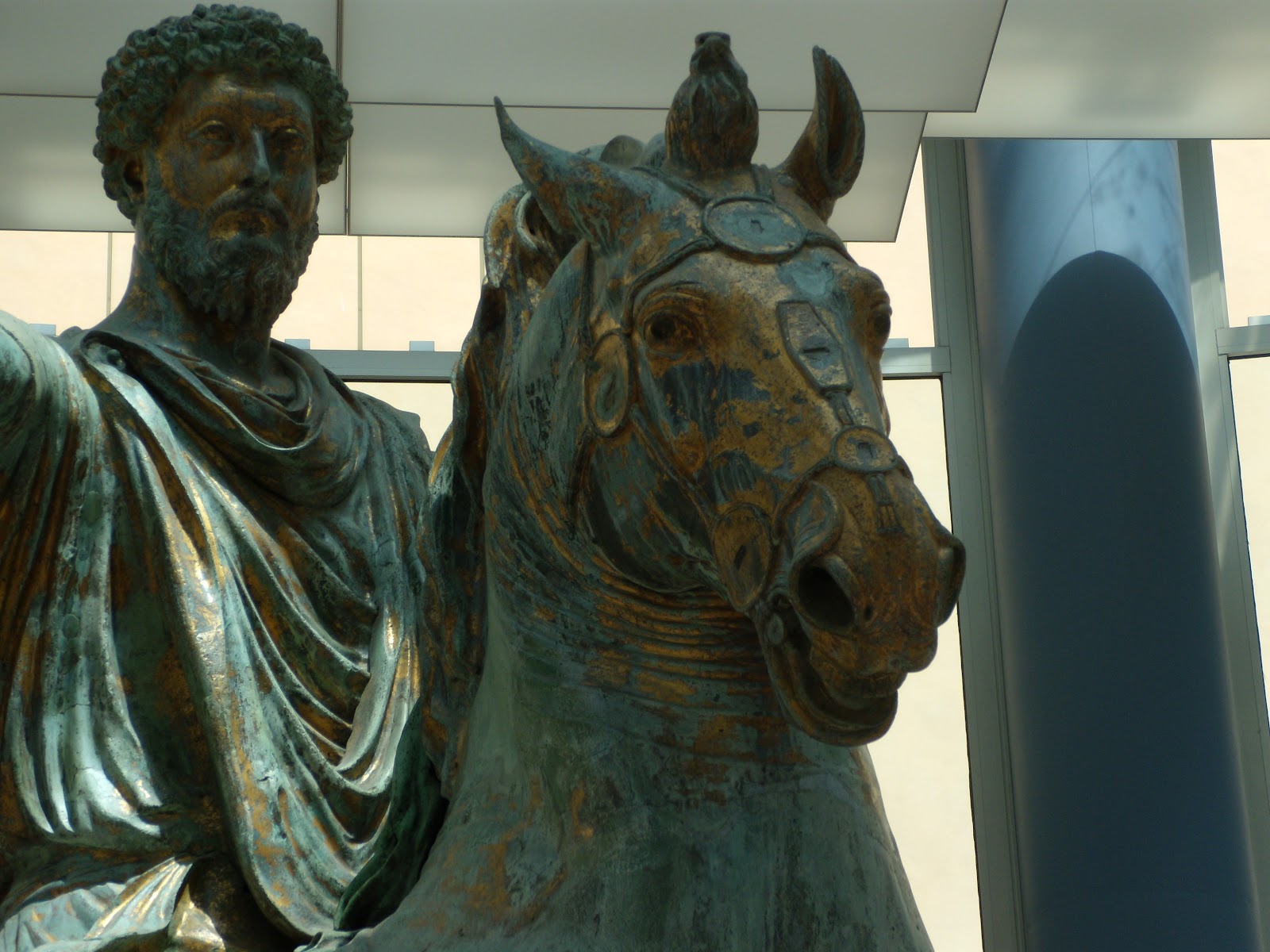
 After packing my bags, checking out, and locking my bags up at the Casa la Salle, I headed over to the Capitoline Museum with Susan and Jim. We saw the famous bronze equestrian statue of Marcus Aurelius, we saw the "Dying Gaul," and much more. It was fun.

Equestrian Statue of Marcus Aurelius
Diana the Huntress
The top floor had a special exhibit. Susan and I saw some bronze pieces, including a particularly striking statue, from the House of the same Julius Publius that we visited on our second trip to Pompeii-- the one where they found the corpses. The house in Pompeii had  Disney-like holographic projections. Publius was an art collector and the bronzes gave us just a little taste of his collection. Nice!

 For more pictures from the museum, visit this set on Flickr.

 This afternoon was spent loading up the bus and moving to the Hotel Villa Rosa in a part of town called Trastevere, which is from Latin “trans Tiberim,” which means, “across the Tiber.” It is more an extension of Rome, a very ancient one, rather than a part of Rome proper. But it is not far outside of town. There is good transportation by tram and by bus, so I think the group will adjust quickly. Jessica, my roommate, and I miss the electrical outlets and the internet connectivity at Casa la Salle, although there are some internet cafes close to the hotel. Not much is open on Sundays, so we took the Number 8 Tram back towards Rome to find a decent dinner. 

The hotel is up some stairs from the main street through this part of town, the Via Trastevere. It's on a tiny side street. We were were told if we get lost to ask for the Trastevere Train station, because the hotel is located across the Via Trastevere from there.
  
My boyfriend, Don, and I had a very nice, and probably final, Skype call last night. He told me my tomatoes are ripening faster and heavier than he can eat them. Did I mention I'm an avid gardener? 

 He plans to make salsa. I wish I could help him. 

I am looking forward to meeting my son, Matthew, on Saturday morning, though, and having a nice time in Rome when he gets here.

I would like to thank the National Endowment for the Humanities for funding this portion of my studies.
Saturday, July 14, 2012

Two Teachers at the Vatican Museum

Saturday, 7/24/10


 My friend, Susan, and I spent most of the day at the Vatican Museum. Susan is an artist and art teacher from Chicago.What a fantastic day! We both like to move slowly through the galleries, taking in everything we can of the art. We both take time to read the placards and listen to the audio-guide, which we both rented. I got some great digital pictures of inscriptions and mythology-based art, particularly of statues from the Classical, Hellenistic, and Neo-Classical periods. I am sure these will make their way into the classroom. 

Laocoon

We were both pleasantly surprised to see what a fine collection the Vatican has of modern art. I only took a few photos of pictures I liked or found intriguing, but Susan could not get enough of the modern work, mostly paintings, once she noticed the quality of the collection. We had the contemporary art section and the lovely Etruscan section of the museum almost to ourselves toward the end of the day. We also enjoyed the gallery with the Greek vases, although I couldn't take many pictures due to problems with the reflections because the work was in cases. For more photographs, visit this set on Flickr.

"Crucifixion," by Salvador Dali, 1954

 The Sistine Chapel, once we got there in late afternoon, was crowded but not insufferably so. The audio-guides helped us remember important points about the paintings and focused our attention despite the crowds. I wish visitors were allowed to take pictures in the chapel, but sadly we were not. I had not been to the Sistine Chapel since Michelangelo's Last Judgment had been cleaned and restored, so I enjoyed getting a good look at these frescoes anew. Susan and I both said we much  preferred the audio-guides to paying for a guided tour. Seven Euros for the audio-guide vs. 45 Euros for a guided tour seems like a no-brainer, although we did have to stand in line for about an hour to get into the Vatican Museum. The guides do get you in faster. Susan and I said it was definitely worth the wait to take things at our own pace.

Since we enjoyed each others' company at the museum so much, we decided to head for the Capitoline Museum together tomorrow. But we will need to pack first. The group is moving to the Villa Rosa tomorrow afternoon, but we need to be checked out of our rooms by 10 AM. I think we will all miss the Casa la Salle. It has been a lovely stay here.

My enduring thanks go to the National Endowment for the Humanities for making this portion of our trip possible.

Friday, July 13, 2012

The Roman Mysteries

Friday, 7/23/10


 This was a quiet day. The morning was spent in lecture, discussion, and translation sessions. Nadine uses historical novels to teach her very diverse 6th-grade class. She shared selections from Caroline Lawrence's, The Thieves of Ostia, which were very good. Even though I teach high school students, I suspect I could get some of my own students hooked on these books. The series is called, “The Roman Mysteries.” After lunch I did my PT exercises, then wandered around this part of Rome a little. For tomorrow I want to visit the Vatican Museums. My friend Susan wants to go with me. We found a bus stop nearby where we can take a bus that will hopefully drop us off a little closer to the Vatican than we can get on the Metro system. I went to the Metro system and figured out how to purchase myself a week-long public transportation pass for 16 Euro. That will get me through the weekend and help out when we are at the Villa Rosa this coming week. My understanding is that it is not as conveniently located as this place, so we may want to take buses to find good restaurants, etc. I also took a picture of a sign near the ticket booth that said, in various languages, “Beware of pickpockets.” I had a nice Skype talk with Don this evening. It was pleasant; almost like sitting across from him at his kitchen table. We both miss each other and enjoyed the visit.

Beware of Pickpockets--Whatever Your Language!

I would like to thank the National Endowment for the Humanities for making this portion of my trip possible.

Thursday, July 12, 2012

From an Empress' to a Martyr's Palace

Thursday, 7/22/10

Wall Painting from the the Empress Livia's House

 The internet is back, and I had a nice, long Skype-call with my mom back in the states. I missed Matthew, though, who went to the beach with his dad. I hear he is very excited about  meeting me in a little over a week in Rome for his portion of the trip.

Antinous as Silvanus
 Today the group went to Rome's National Archeological Museum at the Palazzo Massimo. It is a new museum, and it is wonderful! Highlights were frescoes from Livia's house where the Primaporta Augustus was found, the Diskobolos statue, mosaics, and a magnificent coin collection that I very much want to revisit. 

There is a statue of Antinous, Emperor Hadrian's favorite, in the form of the god Silvanus, that caught my interest. The sign said nobody knows what he was carrying in his left arm. The statue looked a lot like one I had seen and taken a picture of in Capua, so I got the director of the museum's email address so I could email the picture and suggest that the missing item was a cornucopia. I later found out it might have been a branch or other object when I found more information online about this rustic Roman deity: http://en.wikipedia.org/wiki/Silvanus_(mythology) .

 After lunch on our own, the group met at St. Peter's Square to take a tour of its Necropolis, or city of the dead, beneath the basilica itself. We got to see St. Peter's Tomb and St. Peter's ashes. When I get a chance I want to study up a little about the martyrdom of St. Peter. It doesn't sound as though he had an easy death. Something about being crucified upside-down. We returned at 6:30 for another translation session with presentations, so it has been a very, very long day. I skipped the PT exercises and hope the extra stair-climbing we did suffices for today.

 I am finally getting comfortable with the bus and metro system from this end of town and wish we could stay here in stead of moving to the Villa Rosa on Sunday. For more pictures and some video from this day of the trip, see below and visit this set on Flickr.
A Hippo-Hunt on the Nile
Inside St. Peter's

An Interior View of St. Peter's Dome

My eternal thanks to the National Endowment for the Humanities for making this portion of my trip possible.

Monday, July 9, 2012

What was "peace" to an ancient Roman?

Wednesday, 7/21/10

Susan and I at the Castel Sant'Angelo with St. Peter's in the background

  Still no internet. Henry Bender spent another morning with us. After a detailed lecture, he took us to the Ara Pacis, Augustus' famous Altar of Peace, which is across from his Mausoleum. This is not its original location, since it was originally part of Augustus' horologium or giant sundial. The archaeological recovery of the altar and its placement came about under Mussolini.


Tellus Relief from the Ara Pacis

 According to the brochure from the Museo dell'Ara Pacis:

The Ara Pacis is one of the finest examples of classical art. The Roman Senate voted for its construction in 13 B.C. in honour (sic) of Augustus' return from the provinces of Spain and Gaul, where, in the course of three years, the emperor had consolidated both his own personal power and that of Rome, created new roads and founded colonies. The Altar was built on the Via Flaminia, at the northern limit of the Campus Martius (Field of War)...
 One thing that has been reinforced on this trip is that the Romans did not think of “peace” the way most of us do. To a Roman, true peace came as a result of conquest. Augustus' breastplate on the “Primaporta Augustus” even reinforces this concept and the idea is reflected in the iconography of the altar. I hope to get to see the famous marble original of the Primaporta when I get to the Vatican Museum on Friday.


Castel Sant'Angelo

 We saw and had a lecture about Augustus' Mausoleum, but it is undergoing renovations and was unavailable to visit. We did see Hadrian's Mausoleum, now called Castel Sant'Angelo, which was inspired by Augustus' Mausoleum in its cylindrical shape. I learned that not just the emperors and their immediate families were buried in these tombs but a long line of their successors. Hadrian's Tomb looks quite different today due not only to the loss of external marble decorations but also to construction added during later times. The museum had a nice exhibit of ancient artifacts and Renaissance frescoes and paintings. The view from the top, especially in the direction of St. Peter's, was wonderful. For more pictures, visit this set on Flickr. Susan and I are starting to learn the public transportation system a little better and took the #46 bus from near Hadrian's Tomb almost all the way back to the Casa la Salle where we are staying. It was an adventure yet much more restful than walking.


View of the Tiber from the Castel Sant'Angelo

 Tonight Sophia gave the group a nice lecture on ancient Roman libraries, which were often either privately owned or part of temples or bath complexes if public.

I would like to thank the National Endowment for the Humanities for making this portion of our adventures possible.

Sunday, July 8, 2012

A Forum, St. Peter's, and Gladiators--Oh, My!

Tuesday, 7/20/10

Enjoying St. Peter's Basilica

 Today we had a brilliant and lively lecture by Henry Bender, an expert on Augustan Rome. We looked at Augustus' forum. Susan and I had a nice lunch near the Colosseum. We were  supposed to go in, but we didn't want to brave the crowds at that time of day. We have both been there before, although it might have been nice to see the special exhibit on gladiators on the top floor. I heard it was good. Susan and I did a little shopping and took each others' pictures in St. Peter's Square. After our presentation and translation session tonight, our group had a little picnic on the grounds of our hotel. The day would have been almost perfect if the internet had been working at the hotel. I would love to Skype my mom and Matthew. For more pictures of the monuments of Rome, visit this set on Flickr.

My thanks to the National Endowment for the Humanities for making this portion of my trip possible.