Showing posts with label Latin. Show all posts

Saturday, August 4, 2012

What I Learned from My Summer in Italy

The nuts and bolts of Classical Culture in the Amtrak Train Station under Washington, D.C.


Lessons I learned from my summer in Italy in 2010:

  • Upper-class Romans had a less firmly delineated concept of public vs. private spaces than we do. Business was transacted from the home quite often, with clients coming to the door at dawn. There were also no separate spaces for children, making Roman homes very different from our modern homes.
  • Masters' spaces were  delineated from the slaves' spaces in the homes in a clear manner through the use of decoration, which also emphasized the importance and the tastes of the master and his family.
  • Public spaces such as public buildings, public works, venues of entertainment, temples, and even tombs could be used to promote the needs of and to publicize the “private” family through inscriptions, sculpture, etc.
  • There was more of a middle class and a working class in ancient Roman society than I realized. There was also more social mobility than I used to think, although most people probably were born poor and died poor.
  • Archeologists like to find drains to find out what Romans ate and about their daily life from what they flushed down the drains. Eww, but true!
  • Capri and Ischia are two of the most beautiful and pleasant places on earth. I would like to learn more about Axel Munthe.
  • The war-like Samnites gave the Romans more of a problem in its Republican history than I ever realized. Samnite tomb paintings foreshadow the Romans' love of beast-hunts and bloody gladiatorial games.
  • I am tougher than I and even other people think. Fellow participants expressed their doubts I would make it through the whole program with my injured knee. But I did, and I'm stronger for it. I even made it to the top of Mt. Vesuvius and into the substructure of the Amphitheater at Capua by the end of the trip, adventures I didn't dare attempt at the beginning.
  • Italy seems less crime-prone than when I last stayed for an extended time in 1988. I heard fewer tales of members of the group being ripped off by taxi drivers or robbed by pickpockets. I saw NO bands of Gypsy children roaming in large groups with boxes or newspapers over their arms to pickpocket tourists, although I saw Gypsies in small “family” groups or older individuals begging. I'd love to know the reasons behind the change in tactics.
  • I should have memorized the PIN numbers of ALL the credit and debit cards I carried with me, just in case I needed cash. Which I did.
  • An unlocked Italian cell phone with a SIMS card is a nice thing to have. But don't activate it by sending in your passport information until right before the trip because the TIMS company will start charging you money before you even arrive in Italy, wasting money and losing out on service. Or just pay the minimum and rely on free incoming and emergency phone calls with no outgoing calls, like I eventually did.
  • Don't put tildes in any of your passwords before you go to Europe. It's impossible to find them on the keyboards there, which I guess is why it's a good security feature in one's passwords at home.
  • Others may be stronger at remembering names, dates, and historical details than I am, but I'm a strong Latinist. I liked having the opportunity to sight-read Latin this summer. I also got better at reading inscriptions and, to a lesser extent, graffiti.
  • My son, Matthew, is growing up to be a fine young man and good company.
  • A guest house or casa per ferie in Italy can be just as nice as a hotel, cost less, and support a cause. Some even have free internet connections.
  • My favorite spot to stay in Rome is the Hotel Villa Rosa in Trastevere, although I'd like it even better if it had internet access, preferably included.
  • I want to learn even more Italian if I ever have reason to come back here again.
  • The Romans believed in peace, but they thought that peace could only come at the end of a sword. And that sword might as well be theirs.
  • There are nice people everywhere, and most people are nice.
  • Don Burke is the best friend I've ever had. (PS: He later became my husband!)
  • I want to travel some more. But having said that:
  • There's no place like Rome, but there's no place like home.

If you enjoy these adventures and would like updates on my other travels near and far from home, follow me at http://mlbstravels.blogspot.com/, If you would like to your Italy in July of 2018, click here for tour information.

Saturday, July 28, 2012

Lavish Views, Luxurious Villas, and an Animal-Lover

Friday, August 6, 2010


 Wednesday we went to Oplontis to the so-called “Villa of Poppaea”. This was my second trip there this summer but with different lecturers I saw the site with whole new eyes. It was interesting to look at the layers of ash, pumice, and pyroclastic flow that covered the villa before the archaeologists dug it up. We also looked carefully at the styles of wall-paintings in this well-preserved upper-class home outside of Pompeii.

Layers of ash, lapilli, and pyroclastic flow can be seen behind Matthew


In the afternoon we took a hydrofoil to Capri for two nights. We returned this afternoon. What a great time! We saw the Villa Jovis, one of Emperor Tiberius' villas. We stayed at a four-star hotel on Anacapri called the Hotel San Michele, which boasts the largest swimming pool of all the hotels on Capri. This trip is usually a highlight of the end of this two-week program, but we had to do it this week due to scheduling conflicts. Apparently next weekend is a major Roman holiday, and hotel rooms on Capri are not to be had for love or money.

"Capri" means "goats." Here are capri on Capri! We were near Tiberius' villa.


 Matthew and I enjoyed taking the Funiculare, a kind of tram that climbs up and down the hill, to the beach, where we took a boat tour around the island. We didn't get into the Blue Grotto due to tides and weather. This cave may have been a dining room for Tiberius. Fragments of statues of Tritons were found in the cave which could connect him to it. 

Mother and son enjoy the boat tour around the island

Heading for the "Kissing Cave" on the boat tour


We also visited the Villa San Michele, quite near the hotel, which is a former residence of the Swedish-born physician and writer, Axel Munthe. He died in 1949 but lived an intense life. I plan to look up his book, The Story of San Michele, when I get home. It sounds like a great read. His love of the island of Capri resonates in the book and helped popularize it as a destination. He was also quite the animal-lover, according to the signs at the museum.

A photo of Axel Munthe, the animal lover with his menagerie

The gardens of Axel Munthe's home, the museum at San Michele, are as gorgeous as the views!

The views from San Michele, just like views all over the island, are fantastic, and the grounds and gardens are worth the visit in themselves. I also got some nice inscriptions from a cemetery on Anacapri that will be a nice challenge for my Latin Two students.

One of many spectacular views on Capri

 San Michele is Italian for the Archangel Michael, by the way. There used to be a church by that name on Munthe's property, which may have been another villa of Tiberius' in a former life. The property was run down when Munthe bought it and fixed it up. Munthe liked Classical antiquity. There are even a couple of sphinxes, one Etruscan and one Egyptian from 1200 B.C.E., on the property. 

I thought it most interesting that as a physician, he never billed for his services. He found some wealthy patrons who supported him quite lavishly but he served the poor as well, including a stint in the Red Cross during WWI. For more pictures from this leg of our trip, visit this set on Flickr.

Tomorrow we go back to Pompeii. I had better rest up while I can!

Wednesday, July 18, 2012

Water, Water, Everywhere!

Wednesday, 7/28/10

Fontes Bandusiae at Horace's Villa

  This morning a bus came, a private coach, to take our group to the outskirts of Rome. We visited Horace's Sabine Farm in the morning, made famous by his “O Fontes Bandusiae” poem. He said it was simple, and it was, compared to his rich patrons'. But it was pretty fancy. It had a bath complex with a hypocaust system, a swimming pool, and even an aquarium you could walk into to see watch fish behind resin panels.


 Hadrian's villa, on the other hand, was extremely impressive, the size of a town, covering 70 acres or two miles in length. Artwork: statues, frescoes, and mosaics, have been removed from the villa and now adorns museums all over the world. The museum at the site had an exhibition of some of this art, but no pictures were allowed. The statues seen around the main piscina and nymphaeum/triclinium complex are reproductions. The originals are inside the museum.

Hadrian's Villa

 After Hadrian's Villa we stopped at Villa d'Este, which is a palace that belonged to the rich and influential Este family. Hadrian's villa inspired the design, layout, and decoration of the Villa d'Este. During the Renaissance this family even “mined” Hadrian's villa for statues, marble, etc., with which to decorate their villa. Archeologists look at this approach as plundering, but at the time nobles thought of it more as antiquing or reusing of materials, which has gone on for centuries. For more pictures and video from this day, visit this set on Flickr.
Villa d'Este

 All in all it was a full day. After a quick, light supper, I got my PT stretches done but skipped the strength exercises and called it a day. Tomorrow we visit Etruscan tombs, for which I have a fondness... not quite the fondness I've redeveloped for Italian ice cream (gelato), but close.

My thanks to the National Endowment for the Humanities for making this experience possible.

Tuesday, July 17, 2012

Cestus' Pyramid, Ostia, and the Opera!

Tuesday 7/27/10

The Pyramid of Cestus

This morning the group took the Number 3 Bus to a stop near the Tomb of Cestus in Rome. Cestus built his tomb right in Rome's ancient Pomerium, the sacred boundary line within which nobody was supposed to be buried. So his tomb is in the wall, visible from both sides of the Pomerium, but to keep it legal his body was buried in the part of the pyramid that was outside the boundary. He was quite wealthy. He must have been, to pull off a stunt like that! The pyramid, along with the mosaics, frescoes, and obelisks we have seen, show how much Egypt had captured the imagination of the Romans in the first century B.C.

 From there we took a train to Ostia Antica, Rome's ancient harbor. Os in Latin means mouth, and so Ostia means something like Portsmouth. It was located at the mouth of the Tiber River. It was a little shallow, so merchandise was warehoused there and reloaded onto smaller boats or barges to go up the river to Rome itself. It was important to Rome both commercially and militarily. Residents of Ostia were even exempt from military conscriptions in honor of its historical military importance. In its earliest days it was set up as a colony of Rome as a type of castra, or military camp, and it grew in size from there.

Lee demonstrating the use of a Roman latrine
 Ostia is similar to, yet different from, Pompeii and Herculaneum. Unlike the other two cities, it was very much a working-class town. Absent for the most part are the luxurious villas that are found in the other cities. Most people lived in apartment buildings. Artwork was simpler. Its mosaics are lovely, however, and give us a sense of the daily activities and mercantile aspects of the port. For more pictures, visit this set on Flickr.
Ostia is famous for its mosaics

While Pompeii and Herculaneum were destroyed by volcanic eruption, Ostia died a slow death due to the silting up of the Tiber River. The river basically just shifted away from Ostia over time. Eventually a new port named Portus, or Harbor, had to be built to meet Rome's needs, and while people lingered on in Ostia, it was a ghost town by the fifth century A.D. What's nice is that the upper floors of buildings are better preserved than at Pompeii or Herculaneum because it didn't suffer the wrath of a volcano, and there are places where you can even walk on the upper stories. We also spent some time exploring under one of the baths and getting a better sense of its hypocaust, or heating system. We could have taken the train from there to Ostia Lido, which is a beach close to Rome, but a friend with a guidebook said he'd read it isn't such a nice beach compared to those you can see in the South, so I figured I'd hang onto my memories of my perfect afternoon on Ischia and skip this beach..


The theater at Ostia still hosts performances

 Tom got tickets for the opera this weekend for those of us who were interested and willing to pay. It is an easy ride from  our hotel to the stop or fermata across from the Circus Maximus on the Number 3 Bus. If all goes according to plan, I will be taking Matthew to see Verdi's Rigoletto on Saturday night at the Baths of Caracalla. I am excited about seeing him and have already bought my train ticket for Saturday morning to take me out to Fiumicino Airport to meet him at 7:45 AM. The train leaves at 7:00 from Track Number 5. I cannot use the pass that  takes me everywhere on the local bus and metro system. The ticket costs 8 Euros one way, which I consider ridiculously high, but it is cheaper than taking a taxi to the airport. I can save money for the ride back to the hotel with Matthew's bags. The ticket is also cheaper than taking the express train to the airport from Termini, the main Metro stop. That ride costs 14 Euros, I'm told. Rome really sticks it to the tourists. I guess that happens everywhere.

My thanks to the National Endowment for the Humanities for making this portion of my trip possible.

Monday, July 16, 2012

Baths of Caracalla, a Gladiator School, and Sacred Places

Monday, 7/26/10

Baths of Caracalla

 The group went this morning to the Baths of Caracalla. In their day they must have been magnificent. They are the best preserved baths of ancient Rome. When opened, they were the largest in the world, but the Baths of Diocletian, built later, were larger. The Farnese Bull and the Farnese Hercules, both huge, impressive statues that we had seen earlier in the Naples Museum, were found here, as were many mosaics, one of the most impressive of which I'd seen in the Vatican Museum. The bits and pieces we'd seen in different places began to come together so that I could imagine the magnificence of this setting in its day, even though they are ruins now. The black and white frescoes were originally from the second floor, which collapsed in past times. There are sometimes opera performances at these baths. I saw Aida here back in 1988, and it was an experience I'll never forget.

Gladiatorial School outside the Colosseum

 We stopped outside the Colosseum for a look at the gladiatorial school. Gladiators stayed there and prepared for the big show in the huge arena next door. They didn't live there, though. They were brought in for the games. The Romans felt it was too dangerous to have armed, trained gladiators living in Rome itself, especially after Spartacus' rebellion.

 Next, most of the group went to the Basilica of San Clemente. Sr. Theresa told us about Saint Clemens or Clement (she pronounced it both ways). St. Cyril, the inventor of the Cyrillic alphabet, is also interred there. There is a Mithraeum and the ruins of an ancient house or apartment complex. There is also an older church beneath the current structure, and we had the chance to visit what remains of all these.

"Christ yesterday, today, always"

 The group was free for the afternoon, so Susan and I went to visit the nearby cathedral of St. John Lateran. We rented an audio-guide, which was excellent. This church claims to be the oldest cathedral in Rome. It is hard to believe it is even older than what we saw in the excavations beneath St. Peter's. St. John Lateran was the seat of the pope before St. Peter's was built, and it is still his church in his role as the Bishop of Rome. It was built after Constantine legalized Christianity in the Roman Empire, and there is a monument, an Egyptian obelisk, with inscriptions to Constantine in the nearby square. 

As we listened to the audio-guide, we were in awe of the history of the place. Handel played on one of the organs, the one over the side entrance, for example. We really got some feel for how old the place was as we strolled through the cloisters. The monuments, layout, and much of the artwork and tombs reminded us of what we had seen in the Classical tradition. I took pictures I thought would interest my students, particularly of Latin inscriptions. I thought several were easy enough for them to read. We stayed for several hours, until we were too tired to do any more, and then we caught the number 3 bus back to Trastevere. Our hotel is really quite conveniently located, close to the end of the line for this bus, which is at a major terminal.

For more pictures from this day, visit this set on Flickr

My  thanks to the National Endowment for the Humanities for funding this portion of my studies.

Sunday, July 15, 2012

The Capitoline Museum and a New Place to Stay

Sunday, 7/25/10

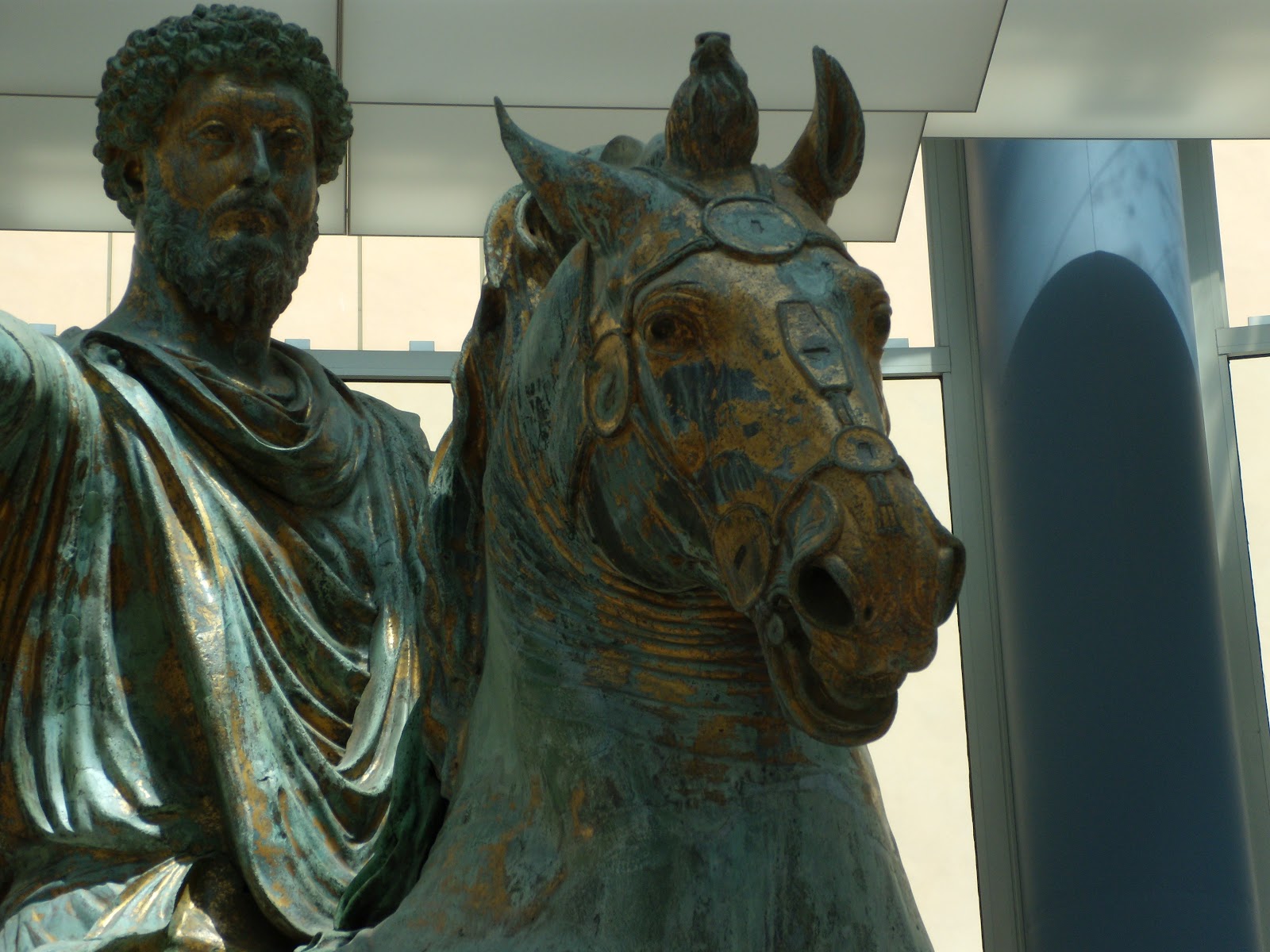
 After packing my bags, checking out, and locking my bags up at the Casa la Salle, I headed over to the Capitoline Museum with Susan and Jim. We saw the famous bronze equestrian statue of Marcus Aurelius, we saw the "Dying Gaul," and much more. It was fun.

Equestrian Statue of Marcus Aurelius
Diana the Huntress
The top floor had a special exhibit. Susan and I saw some bronze pieces, including a particularly striking statue, from the House of the same Julius Publius that we visited on our second trip to Pompeii-- the one where they found the corpses. The house in Pompeii had  Disney-like holographic projections. Publius was an art collector and the bronzes gave us just a little taste of his collection. Nice!

 For more pictures from the museum, visit this set on Flickr.

 This afternoon was spent loading up the bus and moving to the Hotel Villa Rosa in a part of town called Trastevere, which is from Latin “trans Tiberim,” which means, “across the Tiber.” It is more an extension of Rome, a very ancient one, rather than a part of Rome proper. But it is not far outside of town. There is good transportation by tram and by bus, so I think the group will adjust quickly. Jessica, my roommate, and I miss the electrical outlets and the internet connectivity at Casa la Salle, although there are some internet cafes close to the hotel. Not much is open on Sundays, so we took the Number 8 Tram back towards Rome to find a decent dinner. 

The hotel is up some stairs from the main street through this part of town, the Via Trastevere. It's on a tiny side street. We were were told if we get lost to ask for the Trastevere Train station, because the hotel is located across the Via Trastevere from there.
  
My boyfriend, Don, and I had a very nice, and probably final, Skype call last night. He told me my tomatoes are ripening faster and heavier than he can eat them. Did I mention I'm an avid gardener? 

 He plans to make salsa. I wish I could help him. 

I am looking forward to meeting my son, Matthew, on Saturday morning, though, and having a nice time in Rome when he gets here.

I would like to thank the National Endowment for the Humanities for funding this portion of my studies.

Tuesday, June 12, 2012

Pompeii, First Visit 2010

One of the victims of Mt. Vesuvius' eruption in August of 79 A.D.

Monday 7/5/10


For readers who have just found this site, this is a travel-log of a Latin teacher's grant-funded summer study in Italy in 2010. Click here for more info.

Today our group took its first visit to Pompeii. The site is as hot and almost as crowded as I remember. One improvement is the fact that the ancient public water fountains have been fitted with spigots so we can refill our water bottles. Between that and the shade our group leaders tried to steer us toward, this was the most comfortable trip to Pompeii I've ever taken. It's my third or fourth trip over many years.

Ancient water fountain with modern spigot. The worn spot is from ancient pots being lifted up and rested on the lip.
 
There are two railway stations in Castellamare di Stabia. To get the site, we got to the proper train station and boarded the train  to get off at the third or fourth stop, Pompeii Scavi.
Exploring Pompeii's forum

The tour itself was excellent. Different members of the group had been assigned different houses, and they had done their research and were amazingly well prepared. We saw the House of the Faun, of Menander, of the Small Fountain, of the Ponza, of Sallust, and of the Tragic Poet. We also saw the Odeon, which is the smaller of the two theaters, the temple of Isis, and the Fullery where clothes were washed. Mid-day we met with Steve Ellis of the University of Cincinnati in Ohio. He is an archeologist in charge of a dig that is not open to tourists. He had invited our group to come to the site of his dig where he gave a fantastic presentation of the work his team is doing on the more “middle class” houses in Pompeii. I was excited to get pictures and video of archeologists at work for my students.
Steve Ellis comments on recent excavations

It was also interesting to learn that his team was excavating the drains of these houses, examining the food remains there to get a better idea of the diet of the residents. He said two houses looked the same, but the food remains in one showed that the inhabitants were probably much wealthier due to the wider variety of food and the fact it had been imported. Some was very exotic, like the knee of a giraffe, a unique find in Italy. A National Geographic special is coming out this year. It is a series and Steve's dig is in one part of the series. Its name will be “Rome Unwrapped” and this work will be featured in the Pompeii section.
 
I think I have walked around Castellamare di Stabia enough now that I can find my way during daylight into town and back. I have some errands to run while the stores are open, but now I need to find my own necessities around our group's schedule. Today on our way back the stores were still closed for the afternoon. They seem to reopen around 5 PM. To give you an idea of the intensity, the earliest we could get back into town was 4:30 PM, when we all desperately wanted a change of clothes and a shower to cool down. After taking care of our personal needs, our group will meet this evening at 6:30 for a discussion and Latin translation session before dinner at 8 PM. Tomorrow we go to visit the temple of Vedius Pollio, to Cuma (ancient Cumae) to visit the acropolis and the “Cave of the Sibyl” and then the site of the ancient remains at Baiae “with its luxurious accommodations for the very wealthy and its unusual baths along with the Museo di Castello di Baia to view artifacts taken from the sea and surrounding area,” according to our handout.
 Tonight's session is in less than 15 minutes and I still want to have a chance to upload pictures to my computer from today and yesterday, as well as the video clips I took. Wish me luck!

I wish to express my gratitude to the National Endowment for the Humanities for making this portion of my trip possible.

Sunday, June 10, 2012

Free Time in Campagna, Italy

The Grandeur of the Greek Temples at Paestum

Sunday, July 4, 2010


Sunday, July 4, was a “free” day. The group split into two groups more along the lines of age rather than whether we were Latinists or not. The younger group took a ferry to Capri and took a boat tour and hiked up to see Tiberius' villa. They also got to see the Blue Grotto... I would have liked that! 

The young-at-heart generation followed a tour leader, Tom, to Paestum to see the museum and ruins there, particularly the Greek “Tomb of the Diver” and the incredible Greek temples. Southern Italy was dotted with Greek colonies for centuries, giving the culture of the south a different flavor from Rome and the north. For more pictures of Paestum, visit this set on Flickr.

It was worth the trip despite the fact we missed a train. This forced us to delay in the lovely town of Solerno where we saw its “Duomo,” which oddly doesn't have a dome as far as I can tell.
Tomb of the Diver

That evening we were all exhausted, except Sister Therese, who had prepared a detailed lecture about the early history of Pompeii, which she attempted to deliver after dinner between 9 and 10 pm. Unfortunately for her, but perhaps luckily for the rest of the group, she kept getting interrupted by fireworks and so had to cut her presentation short. It sounds like a full day at Pompeii is on the agenda for tomorrow.
Interior over the Nave at Solerno

I have had some serious medical issues with my knee since my Treeing Walker Coon Hound knocked me down on February 4. My orthopedist told me before the trip he thought I would get better without surgery and gave his ok for me to go. I was not sure he was right, but I am walking and going up and down stairs and mostly staying up with the group. And the knee seems to be feeling better each day. It seems a miracle in this land of holy places and healing. I begin to hope that the doctor was right.

Magnificent Temple at Paestum
Many thanks to the National Endowment for the Humanities for making this portion of my trip possible.

Monday, May 28, 2012

Beginnings in Maryland


 My Italy adventures during the summer of 2010 began in late June at Notre Dame of Maryland University. I traveled to Baltimore by Amtrak train and was met by a representative of the campus, who took me and my bags by car to a pleasant residence hall. The two Roman Catholic nuns who were running the program were Sr. Therese Dougherty and Sr. Theresa Lamy. Therese, in general, ran the academic end of the program, and Sr. Theresa ran the administrative end. Both were helpful, kind, and wonderful! The campus was lovely as well. The summer study program they ran had been funded by the National Endowment for the Humanities.

Sr. Therese

Sr. Theresa

About five months before my adventures began, my Walker Hound accidentally knocked me down while he was playing with his friend, a standard poodle mix. Walkers are fast, powerful animals, and he tackled me in the left knee with his shoulder. The pain was incredible, and my knee has never been 100% right since then. My orthopedist, Dr. Shall, suspected he knocked my patella (kneecap) out of place.

When I started this program, I was still in pain, undergoing physical therapy, taking drugs, and doing all kinds of exercises to strengthen the knee and relieve my suffering. For a while there was doubt, at least in my mind, about whether I could even accept the grants. But Dr. Shall cleared me to go. He told me that if I continued to do my exercises every day I would be 80% better by the time I got back from Italy.

I had doubts, and so did my fellow participants. When I arrived at the campus I walked from our dormitory across the parking lot to the dining hall slowly and with great difficulty. I had traveled to Italy on summer study back in the 1980s, so I knew this trip was not going to be for he faint of limb or faint of heart. But I was determined to give it my best shot and not to hold other participants up.

In the end, Dr. Shall was right. Not only did I make it through the program, but it was actually therapeutic for me. I avoided surgery by doing the exercises. And all the walking, hiking, and stair-climbing I did on this trip strengthened my knee. My time in the summer Italian sun was much less depressing than visiting the physical therapist, too. I even managed to climb Mt. Vesuvius during my second visit, but I'm getting ahead of myself.

I wish doctors could prescribe similar trips, perhaps with a stay at one of Europe's many health-spa resorts, to patients with symptoms similar to mine. If not exactly restful, my summer was certainly healthful for mind, body, and soul. For more images of the campus, visit this Flickr set.

 I should also mention that I spent quite a few months learning some phrasebook Italian. I can't recommend enough at least a little Italian for anybody who plans to spend time in the country. Anyone who has toured the country and told you that most people speak English is WRONG. This is true of the tourist-traps, but not the rest of the country. Besides, it's just polite to learn a little about the language and customs before you go. The most useful thing I did was to pick up some Berlitz Italian CDs in a local discount/close-out store. I listened to these over and over during the course of several weeks, mostly as I was falling asleep. When I felt comfortable I knew the whole disc, I would play them in my car as I traveled back and forth to work, reciting the Italian out loud and playing each section over and over until I was pretty confident I could make myself understood.

It worked pretty well. The main drawback to this method is that you speak enough Italian, and decently enough, that folks that you speak to in Italy actually think you understand Italian. They'll talk to you a mile a minute, and you're not well prepared to follow what they're saying unless you get lucky and they hit something you've practiced in a script. But if you live, like I did, in a spot where it's impossible to take an inexpensive course, it's better than nothing. Even if you take a course, practicing scripted dialogues helps you develop your listening skills and pronunciation. I highly recommend it.

I would like to thank the folks at the National Endowmnent for the Humanities for making this portion of my trip possible.