Monday, June 18, 2012

Naples, Italy

Wednesday, July 7, 2010:

The Farnese Bull


I have so many ideas and reflections I want to share, and not enough time in my day. It is 10  PM here, and I need to complete this entry, do my physical therapy stretches, do some minimal labeling of the pictures from the Naples Museum I am uploading while I type this, and get some sleep. I'm also hoping that my wonderful boyfriend, Don Burke, will give me a call. I decided since my Italian cellphone is supposed to work for free incoming calls and emergency outgoing calls, I'll just hold onto it. Of course, the fact that I have no idea how to make an emergency call in Italy is something that bothers me, but not enough to ask-- I feel too busy!


This morning our group took the train and metro system to the National Archeological Museum at nearby Naples. Members of the group who'd lived in busy and sometimes unsafe metropolitan areas were more comfortable with this whole process than I was. I am from an area of North Carolina that has a public transportation (bus) system, but you call for it 24 to 48 hours in advance to schedule your ride, and it takes you to your destination anywhere in the county. I don't even know if the $4.00 fare is one way or round trip, because I've never used it. Also, Naples is known for having pickpockets and purse cutters and purse and jewelry snatchers who particularly prey upon tourists, so I was nervous about that.

The museum was well worth the trip. I got pictures of marble busts of Roman emperors from the Farnese Gallery, which feels like the seeds of a student project. I saw and photographed the magnificent Farnese Bull. I saw and photographed a slew of frescoes from Pompeii and Herculaneum, mostly focusing on mythology for another potential student project, but I also took pictures of scenes that struck my own interest. Another participant, Susan,, a teacher from Chicago Public Schools, and I found we enjoyed each others' company as we walked through the gallery. She looked at the work from a technical perspective while I was looking at the culture the art reflected. I bought a reproduction Herculanean bracelet and a statuette of a faun for a class project.

  Our group was given directions on how to get home. Susan and I got on a slightly wrong train and went  seven stops out of our way. We realized this when we came to the end of the line and our train shut down. The kindly conductor spoke some broken English, and I some broken Italian, and he managed to get us on the right train to where we could get a connection back to Stabia. There we poked around, got some snacks (gelato for me!) and shopping done, and made our way up to the Villa. I took some video that tried to get some feel for the old-style European feel of the streets on our walk from the downtown area up to our hotel, but I'm not sure how good a job I did. I was going to look at the video tonight and label pictures, but I think I only have time to do my stretches and go to bed. I wish I had an easy way to ask a physical therapist or doctor if I am doing any harm by skipping my full exercise regimen. I hope all the walking up and down stairs is doing me enough good as far as strengthening the leg and knee.

 Oh, our evening discussion session was fantastic. Jessica Tang and Jill Howard gave a great presentation on Roman slavery. There seem to be some frightening parallels between the changes in the economy and farming due to the Roman latifundia system and the government-supported farming system today, as outlined in the documentary Food, Inc. and elsewhere. I have a million more reflections but this is all I can manage for now. Tomorrow we are visiting more villas, going to Boscoreale, and hearing a visiting lecturer on I-wish-I-could-remember-what.

 Postscript: I couldn't sleep and wrote a draft of a little poem about Stabia, the little city where we're staying. But that's fodder for another post.

I would like to thank the National Endowment for the Humanities for making this portion of my studies possible.

Saturday, June 16, 2012

Baiae or Baia on the Bay of Naples


Tuesday, July 6, 2010 

View of the Bay from the Baia Museum


Our group visited the ancient luxury resort of Baia on the Bay of Naples today. In its day it was a resort for the exceedingly well connected and wealthy Roman elite. Its reputation was a little shady at times, but the Romans seemed to have loved its pleasures. They practically made the bay a lake both for purposes of making the bay sheltered and secured and to extend the land on which to build their luxury homes. The whole area is extremely volcanic and dotted with natural caves as well as the aqueducts and tunnels that the Romans built. Some of the latter were used by German troops during World War II. Nature's process of slow earthquakes or “bradyseism” causes the floor of the bay to rise and lower, so over time ancient cities have lowered beneath the sea or places under the sea have come up. More information is available at http://en.wikipedia.org/wiki/Bradyseism and other sites. 

 
Tom Hayes told us that one can rent a glass-bottomed boat, and the water is so clear that you can see remains of the ancient city of Puteoli, near modern Pozzuoli, on the floor of the harbor below. Besides the lovely, well preserved statues and inscriptions at the museum, we saw many other sights today: The Acropolis of Cumae and the Cave of the Sibyl with a presentation by participant Anne Glenn, which was excellent. On the way we also saw the Villa of Vedius Pollio, a friend of Rome's first emperor, Augustus. This site has been open to the public for less than two years, so the guides were very eager to show us around. The views and the theaters were spectacular. The guides spoke Italian and no English, but Tom translated for us beautifully. These guides showed us evidence of the German soldiers.
Private Bay for the Homes of the Roman Elite
  
Vedius is famous for his cruelty. A slave once dropped an expensive goblet while Augustus was visiting for dinner. Vedius ordered him thrown to his pet lampreys (like eels). Augustus stopped him by asking to see the rest of the set of goblets, and then deliberately breaking them all himself. It's a good story. 

We stopped at the Tomb of Vergil or Virgil, a Roman poet who wrote in Latin in the first century B.C. There were Latin inscriptions all over. We had a chance to pay our tributes to the bard.

Another View of the Private Bay

The guides also pointed out an allegedly haunted house, not Roman but fascinating all the same. We had another discussion and translation session focused on Roman houses. Tomorrow we will visit the National Archeological Museum at Naples. There will be a discussion session at 6:30 but very little else planned for the day. I am glad we have been promised a slightly slower pace.

More pictures from this day of our trip are posted on Flickr.
Vedius Pollio's Theater and Odeon
Haunted House on its Own Island

I would like to take this opportunity to thank the National Endowment for the Humanities for making this portion of my trip possible.

Tuesday, June 12, 2012

Pompeii, First Visit 2010

One of the victims of Mt. Vesuvius' eruption in August of 79 A.D.

Monday 7/5/10


For readers who have just found this site, this is a travel-log of a Latin teacher's grant-funded summer study in Italy in 2010. Click here for more info.

Today our group took its first visit to Pompeii. The site is as hot and almost as crowded as I remember. One improvement is the fact that the ancient public water fountains have been fitted with spigots so we can refill our water bottles. Between that and the shade our group leaders tried to steer us toward, this was the most comfortable trip to Pompeii I've ever taken. It's my third or fourth trip over many years.

Ancient water fountain with modern spigot. The worn spot is from ancient pots being lifted up and rested on the lip.
 
There are two railway stations in Castellamare di Stabia. To get the site, we got to the proper train station and boarded the train  to get off at the third or fourth stop, Pompeii Scavi.
Exploring Pompeii's forum

The tour itself was excellent. Different members of the group had been assigned different houses, and they had done their research and were amazingly well prepared. We saw the House of the Faun, of Menander, of the Small Fountain, of the Ponza, of Sallust, and of the Tragic Poet. We also saw the Odeon, which is the smaller of the two theaters, the temple of Isis, and the Fullery where clothes were washed. Mid-day we met with Steve Ellis of the University of Cincinnati in Ohio. He is an archeologist in charge of a dig that is not open to tourists. He had invited our group to come to the site of his dig where he gave a fantastic presentation of the work his team is doing on the more “middle class” houses in Pompeii. I was excited to get pictures and video of archeologists at work for my students.
Steve Ellis comments on recent excavations

It was also interesting to learn that his team was excavating the drains of these houses, examining the food remains there to get a better idea of the diet of the residents. He said two houses looked the same, but the food remains in one showed that the inhabitants were probably much wealthier due to the wider variety of food and the fact it had been imported. Some was very exotic, like the knee of a giraffe, a unique find in Italy. A National Geographic special is coming out this year. It is a series and Steve's dig is in one part of the series. Its name will be “Rome Unwrapped” and this work will be featured in the Pompeii section.
 
I think I have walked around Castellamare di Stabia enough now that I can find my way during daylight into town and back. I have some errands to run while the stores are open, but now I need to find my own necessities around our group's schedule. Today on our way back the stores were still closed for the afternoon. They seem to reopen around 5 PM. To give you an idea of the intensity, the earliest we could get back into town was 4:30 PM, when we all desperately wanted a change of clothes and a shower to cool down. After taking care of our personal needs, our group will meet this evening at 6:30 for a discussion and Latin translation session before dinner at 8 PM. Tomorrow we go to visit the temple of Vedius Pollio, to Cuma (ancient Cumae) to visit the acropolis and the “Cave of the Sibyl” and then the site of the ancient remains at Baiae “with its luxurious accommodations for the very wealthy and its unusual baths along with the Museo di Castello di Baia to view artifacts taken from the sea and surrounding area,” according to our handout.
 Tonight's session is in less than 15 minutes and I still want to have a chance to upload pictures to my computer from today and yesterday, as well as the video clips I took. Wish me luck!

I wish to express my gratitude to the National Endowment for the Humanities for making this portion of my trip possible.

Sunday, June 10, 2012

Free Time in Campagna, Italy

The Grandeur of the Greek Temples at Paestum

Sunday, July 4, 2010


Sunday, July 4, was a “free” day. The group split into two groups more along the lines of age rather than whether we were Latinists or not. The younger group took a ferry to Capri and took a boat tour and hiked up to see Tiberius' villa. They also got to see the Blue Grotto... I would have liked that! 

The young-at-heart generation followed a tour leader, Tom, to Paestum to see the museum and ruins there, particularly the Greek “Tomb of the Diver” and the incredible Greek temples. Southern Italy was dotted with Greek colonies for centuries, giving the culture of the south a different flavor from Rome and the north. For more pictures of Paestum, visit this set on Flickr.

It was worth the trip despite the fact we missed a train. This forced us to delay in the lovely town of Solerno where we saw its “Duomo,” which oddly doesn't have a dome as far as I can tell.
Tomb of the Diver

That evening we were all exhausted, except Sister Therese, who had prepared a detailed lecture about the early history of Pompeii, which she attempted to deliver after dinner between 9 and 10 pm. Unfortunately for her, but perhaps luckily for the rest of the group, she kept getting interrupted by fireworks and so had to cut her presentation short. It sounds like a full day at Pompeii is on the agenda for tomorrow.
Interior over the Nave at Solerno

I have had some serious medical issues with my knee since my Treeing Walker Coon Hound knocked me down on February 4. My orthopedist told me before the trip he thought I would get better without surgery and gave his ok for me to go. I was not sure he was right, but I am walking and going up and down stairs and mostly staying up with the group. And the knee seems to be feeling better each day. It seems a miracle in this land of holy places and healing. I begin to hope that the doctor was right.

Magnificent Temple at Paestum
Many thanks to the National Endowment for the Humanities for making this portion of my trip possible.

Saturday, June 9, 2012

Arrival in Italy

Saturday, July 3, 2010

Twilight view of the bay from our room
 Today our NEH group arrived in Italy after a 20 hour journey that involved an emergency change of buses because the first one was too small, an insane ride by a chastened (?) bus driver weaving up and down the New Jersey Turnpike at high speeds, and all the extra security measures of an international flight out of Newark. 

In Italy we went on a bus directly to Castellammare di Stabia, a very ancient city along the coast. We will stay for two weeks at the Vesuvian International Institute, a small study center and hotel atop a hill. Locals know it as the Institute Salesiano because for a long time the building was inhabited by priests and brothers of that order. Because of how some cars were parked and due to the narrow and twisty nature of the ancient streets to the center, the bus could not make it to the door of the center, so we had to quickly unload the bus amid city traffic and walk uphill toting our bags or rolling them over the cobblestones behind us. By the time we arrived we were hot and tired, but we made it.

The Vesuvian Institute: Our Home Away From Home!

Positives: beautiful view of the bay, accessibility to the trains if you don't mind the steep, twisting ascent upon return, excellent food, NICE staff.

Disadvantages, many common in Italy: a rather Spartan room for two, sharing the room key with someone half my age who wants to have a nightlife, hanging laundry out the window although they'll do it for you for a price if you are willing to wait; no outlets in the room for computers and electronic devices except in the bathroom ; VERY spotty wi-fi internet service and not enough connected computers. The keyboards are also different in Europe. I could barely get a message out to Don that I arrived safely and that my phone won't work for outgoing calls. 

The hotel is not particularly quiet and the town is quite noisy, even more so on the sea-side, between groups enjoying the view and celebrating into the night with fireworks, which are commonly set off by family groups for special occasions like weddings, I'm told. And they're not just the little firecrackers that are commonly sold around the Fourth of July in the U.S., but the kinds that require a special license and training to handle in our country. 

The hotel itself lacked some important safety features. There was no evacuation-plan posted in our room, a fire extinguisher on our floor was missing, and a fire hose was missing between two other floors (not ours). In retrospect I probably should have complained, but I didn't. It was not until we checked in at the Casa la Salle in Rome two weeks later that I realized such lapses aren't necessarily normal in Italy. For a video I made of the accommodations, click here.

I would like to take a moment to thank the National Endowment for the Humanities for making this portion of my trip possible.

Thursday, June 7, 2012

The Walters Art Museum

Dionysus and friends


Our group spent one day of our summer study program before our flight to Italy at the Walters Art Museum in Baltimore, MD. It reminded me of our beloved Chrysler Museum in Norfolk, Virginia, near our home.

The Walters is a small but surprisingly high-quality collection, the displays are well laid out, and the building is small enough to feel almost cozy. I highly recommend a visit. Highlights were a Roman lectus or dining-couch, a relief sculpture of a herdsman with his team of oxen, and a beautiful sarcophagus of Dionysus and Ariadne. This was just a little appetizer compared to what was coming in the following weeks, but a very palatable one.

The visit also gave me a chance to practice photography, especially indoors without a flash, before we visited the museums and monuments of Italy. My camera was a Nikon P60 digital camera, which was light enough to carry everywhere and inexpensive enough I didn't worry too much about it being stolen. It took some amazingly good pictures, too, especially as I got used to it.

Relief Sculpture of a Team of Oxen


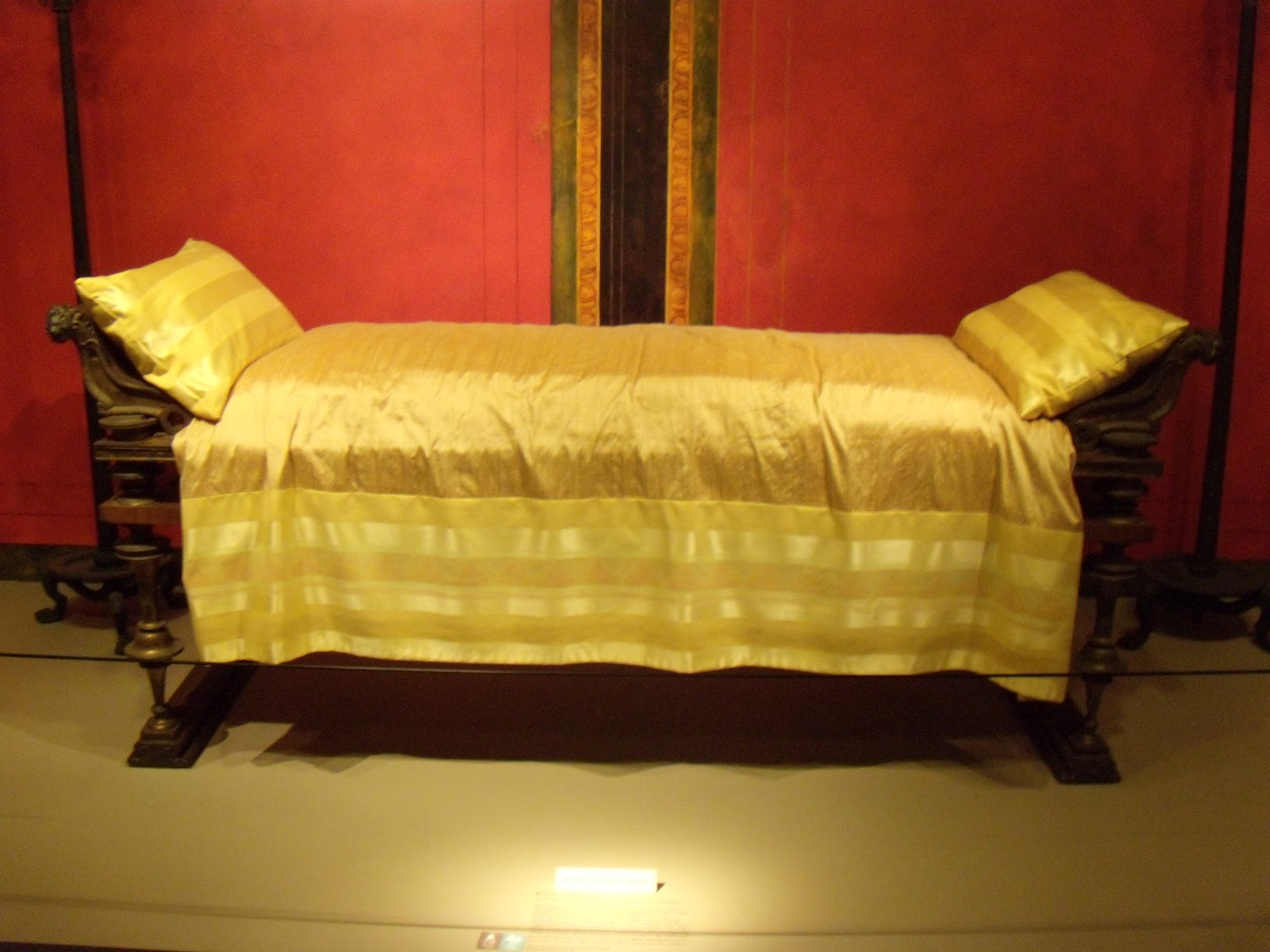
Roman Dining-Couch

Upper-class Roman males generally reclined on their left elbows and ate with their right hands. Traditionally three diners reclined on a couch together, although they must have been much smaller than the average person today, because it's hard to imagine how they could all fit.

I would like to take this opportunity to thank the National Endowment for the Humanities for making this portion of my trip possible.

Sunday, June 3, 2012

Tuesday and Wednesday in MD

The name of the N.E.H.-funded portion of our summer-study program was, "Houses of Gods and Mortals." Our group would be spending time in Italy studying temples as houses of the gods, the architectural remains of ancient houses, and tombs as houses of the dead. It made for a nice thematic unit.

Dr. Glenn R. Bugh, Virginia Tech

On Tuesday, June 29, 2010, Dr. Glenn R. Bugh of Virginia Tech presented a lecture on the archaeology of Roman Italy. The next day he lectured about the Etruscans, an ancient race to the north of Rome that declined in influence as Rome was coming to power. They eventually died out and their language along with them. We mostly know about them from their tombs and from what we can make out of their inscriptions. Dr. Bugh told us there are three types of these tombs:
  • the Aedicula tomb, like a little house
  • the Cassone tomb, like a box or coffin
  • the Tumulus tomb, like a little hill with an entryway

In almost all cases, except Cassone, they were intended to be family tombs. There's a communal nature to the tombs and their use. The tombs are arranged in a necropolis, or city of the dead. There are whole streets of the dead in Etruria. I had visited these tombs in the 1980s. They were a favorite part of my summer study then, and I was looking forward to going back.


Mary Lou presents about graffitti
Although this was an N.E.H. Institute, the format was closer to an N.E.H. Summer Seminar. Participants were required to not only do research but to take on many of the lectures. I had the opportunity to be one of the first participant lecturers. My topic was about ancient Roman graffiti, which is mostly found in Pompeii. I gave an overview about what types of graffiti have been discovered and why we should study it. This presentation dovetailed nicely with Sr. Dougherty's, which followed. She had many more examples of graffiti for the group to study than I had in my rather brief but well-received presentation. To view it  on Google Docs, click here and download.

I would like to thank the folks at the National Endowmnent for the Humanities for making this portion of my trip possible.